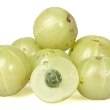
Amalaki (Phyllanthus emblica)
Background
Indian gooseberry (Emblica officinalis), also known as amalaki, is a small- to medium-sized deciduous tree native to India and the Middle East. In addition to its medicinal uses, the fruits are often eaten raw and used as ingredients for various Indian recipes.
In folk medicine, dried and fresh Indian gooseberry is used, including the fruit, seed, leaves, root, bark, and flowers. Traditionally, Indian gooseberry is used alone and in combination with various Ayurvedic herbs for various medical conditions, including pancreatitis, hepatitis, inflammation, cancer, diabetes, obesity, kidney disease, and stomach problems. It is also considered a natural adaptogen.
Indian gooseberry juice contains high levels of vitamin C. Ayurvedic preparations that contain Indian gooseberry may increase the concentration of ascorbic acid by up to three times.
Indian gooseberry has been studied for its effects on diabetes, eye diseases and high cholesterol. However, more research is needed before conclusions can be made in these areas.
Scientific Evidence
Uses | Grade* |
Diabetes mellitus A combination product containing amalaki may improve blood sugar control compared to vitamin C alone. More studies testing amalaki alone are needed. | C |
Eye diseases A combination product containing amalaki may improve eye conditions resulting from infection, inflammation, or degeneration. More studies testing amalaki alone are needed. | C |
Hyperlipidemia (high cholesterol) Based on human research, raw amalaki may improve serum cholesterol levels. However, there is not enough scientific evidence to form clear conclusions about its safety or effectiveness in humans. | C |
*Key to grades:
A: Strong scientific evidence for this use;
B: Good scientific evidence for this use;
C: Unclear scientific evidence for this use;
D: Fair scientific evidence against this use (it may not work);
F: Strong scientific evidence against this use (it likely does not work).
Tradition
- Adaptogen (improves response to stress), allergic rhinitis, anti-aging, antibacterial, antifungal, anti-inflammatory, antioxidant, atherosclerosis (hardening of the arteries), breast cancer, cancer prevention, cancer treatment, cough, dyspepsia (indigestion), fever, heart disease, hepatitis, immune function, jaundice, liver conditions, pancreatitis, skin care, stomach problems, sunscreen.
Dosing
Adults (18 years and older)
Various doses have been studied, and there is no proven effective dose for amalaki. 1-2 capsules have been taken three times daily after meals.
For hyperlipidemia, 50 grams of raw amalaki has been used for four weeks.
Children (under 18 years old)
There is no proven safe or effective dose for amalaki in children.
References
- D'Souza, P., Amit, A., Saxena, V. S., et al. Antioxidant properties of Aller-7, a novel polyherbal formulation for allergic rhinitis. Drugs Exp.Clin.Res. 2004;30(3):99-109. View Abstract
- Jacob, A., Pandey, M., Kapoor, S., et al. Effect of the Indian gooseberry (amla) on serum cholesterol levels in men aged 35-55 years. Eur J Clin.Nutr. 1988;42(11):939-944. View Abstract
- Jose, J. K. and Kuttan, R. Hepatoprotective activity of Emblica officinalis and Chyavanaprash. J Ethnopharmacol. 2000;72(1-2):135-140. View Abstract
- Kumar, M. S., Kirubanandan, S., Sripriya, R., et al. Triphala promotes healing of infected full-thickness dermal wound. J Surg.Res. 2008;144(1):94-101. View Abstract
- Rajak, S., Banerjee, S. K., Sood, S., et al. Emblica officinalis causes myocardial adaptation and protects against oxidative stress in ischemic-reperfusion injury in rats. Phytother.Res. 2004;18(1):54-60. View Abstract
- Sabu, M. C. and Kuttan, R. Anti-diabetic activity of medicinal plants and its relationship with their antioxidant property. J Ethnopharmacol. 2002;81(2):155-160. View Abstract
- Srikumar, R., Parthasarathy, N. J., Shankar, E. M., et al. Evaluation of the growth inhibitory activities of Triphala against common bacterial isolates from HIV infected patients. Phytother.Res. 2007;21(5):476-480. View Abstract
- Yokozawa, T., Kim, H. Y., Kim, H. J., et al. Amla (Emblica officinalis Gaertn.) prevents dyslipidaemia and oxidative stress in the ageing process. Br.J Nutr. 2007;97(6):1187-1195. View Abstract